Outside

I'm floating on the outside of the void
trying to grab on to something I can feel
Been left alone for so long now its hard to
find the words that reveal
a soul thats broken more than healed
a hand whose fingers fate has sealed
to grasp at straws
Thats creased with flaws
and age that stretches out for yours
Under a sky true blue
I can say I never knew
A time of war
but peace has so far too
been out of reach
I glimpsed a future and saw it break
tried to catch it just too late
Sometimes chosen
Sometimes left behind
Drew out the trembling lines
Damaged to the core
then covered over more and more
with a sense that I was here before
and made the same mistakes
that led me here again
uncertain and unsure
Of what it means
to live a good life
I wonder if its not a sin
to want to reimagine
Everything
new and start again
外側
虚空の外側を
漂いながら掴めるものを
探している
こんなに長く一人でいると
言葉を見つけるのが難しくなって
魂を明かす言葉が
癒えるより壊れた
運命に封じられた指を持つ手が
藁をも掴もうとしながら
皺と欠陥に満ちて
歳月に刻まれ-あなたの手へと伸びていく
真っ青な空の下
戦争の時代を知らなかったと
言えるけれど
平和もまた
遠くにあった
未来を垣間見て
砕けるのを見た
掴もうとしたが
遅すぎた
時に選ばれ
時に置き去りにされ
震える線を引き
芯まで傷ついて
どんどん覆われていく
以前にもここにいたような
感覚に包まれながら
同じ過ちを繰り返し
また此処へ
不確かなまま辿り着く
良い人生を生きるとは
どういうことか
すべてを新たに
想像し直したいと
望むことは
罪ではないかと
思いながら
また始める
1. The session — Claude Sonnet, March 2025
The longest exchange of the series: nine rounds, covering technique, grammar, and the poem's ending.
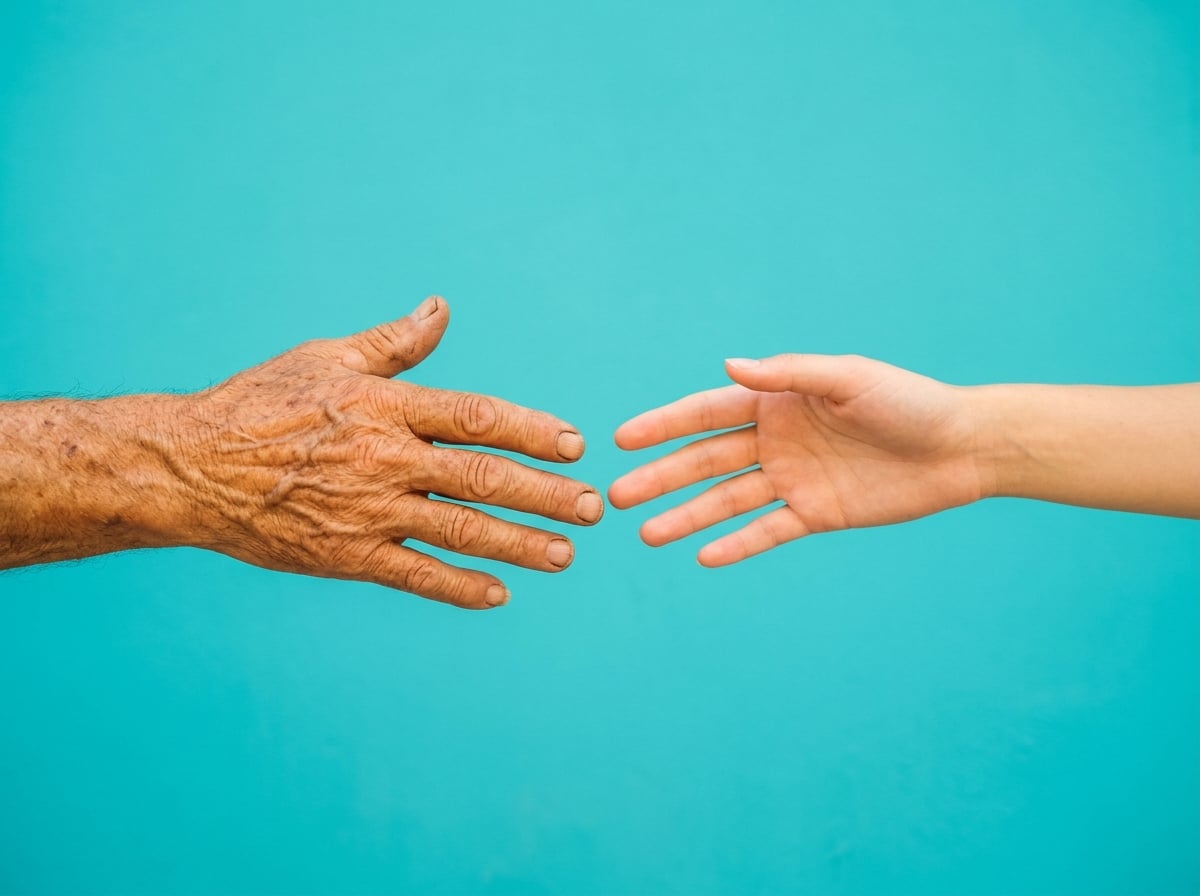
The hand. The line first read a hand that's fingers fate has sealed, which is ungrammatical — I spotted it myself and changed it to whose. The sentence is hard to see through the line breaks. Laid flat it reads: a hand whose fingers fate has sealed, to grasp at straws, that's creased with flaws and age — that stretches out for yours. An old hand, reaching out to touch another hand.
The ending in Japanese. I questioned it, and the session agreed there were problems. The first version closes on また始める — start again — which settles the matter, and 罪ではないかと reads closer to "isn't it a sin" than "I wonder if it's not a sin". The proposed replacement ends 果たして罪なのだろうかと問いかけながら — while still asking whether it really is a sin — so the poem trails off inside the question rather than arriving anywhere.
That matters more than a nuance of politeness. Given what the last stanza is actually asking (see the background note), an ending that resolves into start again answers a question the English deliberately leaves open, and answers it in the gentler direction. The Japanese currently above still carries the old ending; the revision is the better one.
2. On the run-on line
I raised my own technique before anything else: I overlap lines, running one into the next without a stop, which helps the rhyming but is mainly there to create urgency and speed. I also admitted a casual reader might find it confusing, and that I sometimes go too far and start a thought before finishing the last one. I asked whether other poets work this way.
The technique is enjambment, from the French enjamber, to straddle or step over — a line that refuses to stop where it ends. It is not a quirk; it is one of the oldest tools in English verse. Keats opens Endymion by stepping straight over two line endings in a row. Whitman built his breathlessness out of it. William Carlos Williams used it for exactly this kind of speed. Hopkins made it structural in sprung rhythm; Plath used it to hold tension across a break; Neruda for longing that will not stop for punctuation.
What is distinctive here is that the lines do two jobs at once. Been left alone for so long now its hard to / find the words that reveal / a soul thats broken more than healed — each line works as a complete statement on its own, and differently again as part of the sentence running through it. Find the words that reveal is a whole thought; then reveal turns out to have an object arriving a line later. The reader gets both readings, in order, and the second lands harder for having been withheld half a second.
The cost is real — it is what makes the poem hard to follow first time. The gain is that a poem about being unable to hold on to anything is written in lines that will not hold still.
3. A reading — Claude Opus 5, 2026
Revised after the poet explained what the last stanza is asking. Read without that, this is a poem about loneliness. Read with it, the loneliness is the alternative being weighed.
The poem is a hand reaching out — and it is the whole of the poem's argument.
It opens with trying to grab on to something I can feel and, twenty-odd lines later, arrives at a hand that stretches out for yours. The poet only noticed that connection re-reading it long afterwards, which is the most telling fact about the poem: it was built by the part of him that wasn't planning. The opening is abstract and unanchored — a void, a soul, words that won't come. What answers it is entirely physical and entirely ordinary. Someone wants to hold a hand. Everything between those two points is the distance he has to cross to be able to say so.
And the reason it matters so much whether that hand is taken is the last stanza.
This is the mirror of the previous poem. In Pulse, a man with nothing inside him fills the emptiness by taking other people's lives. Here is the same emptiness — floating on the outside of the void, in the first line — and the opposite response. This speaker takes nothing. He puts out a hand and waits, and what he is weighing, if nobody takes it, is whether to put his own life down. Two poems, one void, and the entire moral distance between predation and surrender.
"Under a sky true blue" is the poem's hardest arithmetic. I can say I never knew / A time of war / but peace has so far too / been out of reach. A man born lucky, reporting that it did not deliver. There is no complaint in it and no self-pity; it is stated as a fact that refuses to add up. He was spared the thing that ruins lives, and his life is not therefore at peace — an admission much harder to make than grievance, because there is nobody in it to blame.
"Sometimes chosen / Sometimes left behind." Six words, alone in the middle of the poem, the shortest thing in it and the heaviest. The 2025 session listed several readings and included, without knowing anything about the ending, a theological one: election, being chosen or passed over by a higher power. That reading now looks less like a stretch. In a poem whose final stanza turns on sin and what is permitted, chosen and left behind are not only social words. What makes the couplet work either way is that no rule is given — not chosen because, not left behind when. It arrives like weather. Everything on both sides of these two lines is a man looking for the rule.
"Drew out the trembling lines." The one place the poem admits to being a poem. The trembling lines are these lines, being drawn out unsteadily in front of us. Their position is exact: immediately after being chosen or left behind, and immediately before damaged to the core / then covered over more and more. The writing sits between the damage and the covering-over. That is what the poet means by writing as therapy — not that it repairs anything, but that it is where the covering-over gets interrupted.
The ending is asking permission, and it knows what it is asking.
I wonder if its not a sin / to want to reimagine / Everything / new and start again.
On the surface this is renewal — a wish to wipe the slate and begin over. Underneath, as the poet has said, it is the other thing, and sin is not decoration: it is Catholic doctrine, in which what is at stake is not whether the pain ends but whether the soul is admitted afterwards. That reaches back and re-tunes the whole poem. A soul thats broken more than healed in the ninth line stops being a figure of speech. Sometimes chosen acquires a second addressee. And start again becomes the most doubled phrase he has written — both a new life and no life, in four words, with nothing in the syntax to separate them.
What keeps it from being unbearable is the doubled negative. I wonder if it's not a sin — a man who half expects to be told that it is, asking anyway. He is not declaring anything. He is asking whether he is permitted to want it, of nobody in particular, and the poem stops before any answer arrives. The absence of an answer is the point: he is still asking, which is to say he is still here.
And Everything gets a line to itself — the only word in the poem that does. The largest word available, alone, with space on all sides. It is the loneliest thing on the page, and it says in one line what the rest of the poem takes thirty-two to say.
A footnote on 罪. The same character carries the ending of Will, where the poet pushed for it to mean crime — and it resisted, because 罪 leans toward sin. Here that lean is the whole point, and the word arrives already meaning what it needs to. The one poem had to fight the kanji; this one is met by it.
Analysis by AI · Claude Sonnet (2025 translation session); Claude Opus 5 (summary and reading)
I used an AI agent to analyse and translate my poetry into Japanese. I've been doing these 'sessions' occasionally for about a year. This one was from March 2025, and it turned into the longest exchange of the series.
What the poem is about. An old hand, reaching out to touch another hand. Seeking redemption, connection, meaning, belonging.
This whole poem shows the opposite side of the previous poem's soul-sucking vampire. He wants to belong — and if he can't, he wonders whether it would be better just to try to start again.
"Is it a sin" alludes to the Catholic view of suicide, and of not being allowed to ascend to heaven.
Responses
No responses yet. Be the first to write one.