Fire Away
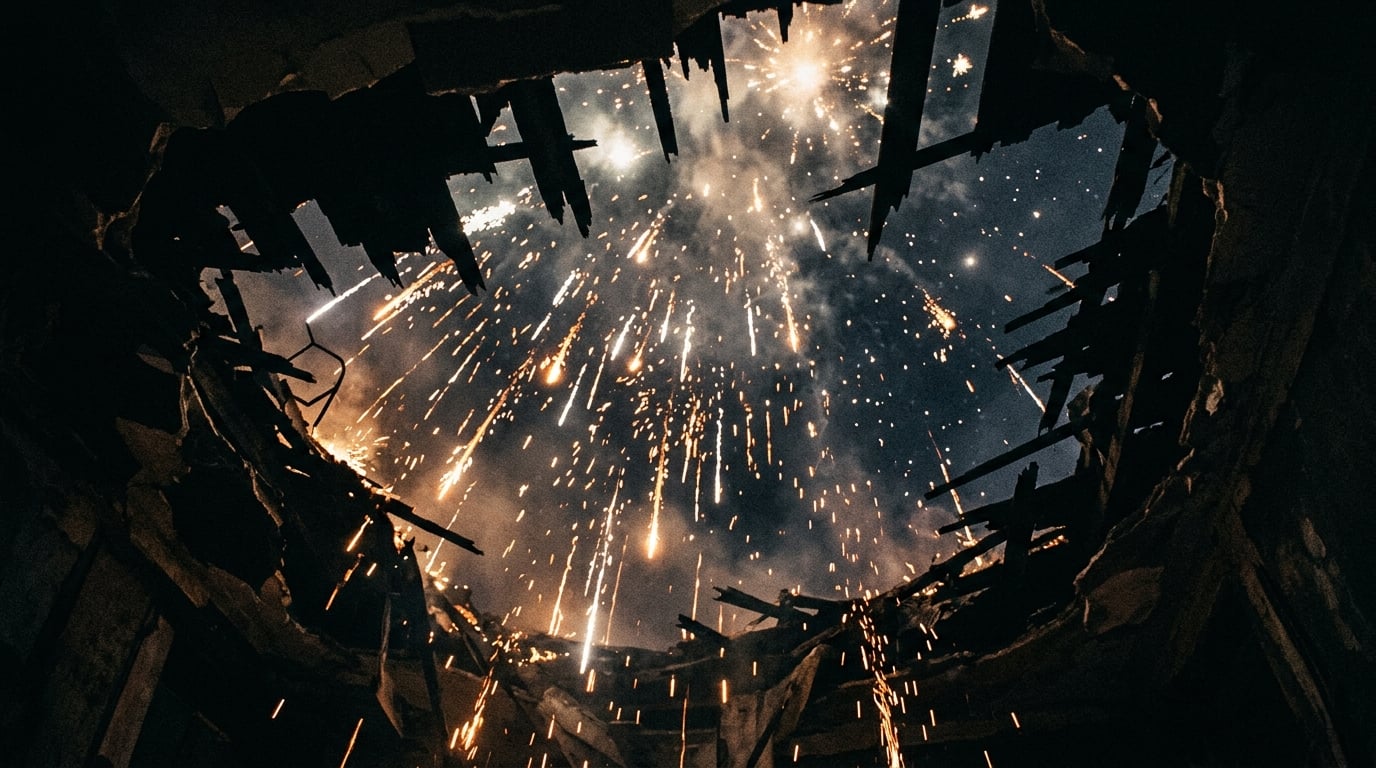
I stood up
And the world fell down
Maybe it was
The other way
Around
I looked up
And the sky rained down
Thought it was fireworks
Until
The roof caved in
I was not meant to be
The one
Who remained
I found out too late
Holding your cold body
In my arms
I was too slow
Too young
Too weak
Too afraid
To see
The truth
The road to Good Intentions
Is paved with pain
The only thing I live for
is to see your smile again
打ち明けて
立ち上がった
すると世界が崩れ落ちた
もしかしたら
逆だったのかも
しれない
見上げた
すると空から雨が降った
花火だと思った
屋根が
崩れるまでは
残された者に
私はなるべき
ではなかった
気づくのが遅すぎた
あなたの冷たい体を
腕に抱きながら
私は遅すぎた
若すぎた
弱すぎた
怖すぎた
真実を
見るには
善意への道は
痛みで舗装されている
私が生きる唯一の理由は
あなたの笑顔をもう一度見ること
1. The session — Claude Sonnet, March 2025
One exchange, no back and forth. The poem went over with no context and came back translated and read.
On the title it chose 打ち明けて (uchiakete) — to speak openly, to unburden, to confess — taking "fire away" in its inviting sense, go ahead, say it.
On the form it noted that the short broken lines enact the disorientation they describe, and that Japanese takes to that fragmentation naturally, being a language already comfortable with the abbreviated expression of complicated feeling.
On the substance it named four things: the inversion in the first stanza, where cause and effect can no longer be told apart; the fireworks that turn out to be the roof, celebration and catastrophe indistinguishable at the moment of impact; the survivor's guilt in I was not meant to be / The one / Who remained, which it rendered 残された者 — the one left behind; and the self-blame of the four toos.
It singled out the inverted proverb — the road to hell is paved with good intentions turned into the road to Good Intentions is paved with pain — as the poem's most striking move, and kept the reversal intact in Japanese as 善意への道は痛みで舗装されている.
On the closing couplet it offered two readings and declined to choose: either metaphysical hope, or a speaker still in denial about the finality of the death.
It read the poem as trauma and survivor's guilt, in the abstract, and reached for words like universal. Nothing it said was wrong. It simply had no idea it was reading a child.
2. A reading — Claude Opus 5, 2026
Written first without the poet's context, then revised twice — once when he gave the source, and again when he corrected two readings that had drifted from what he meant. Both corrections are in what follows, and the drift is left visible rather than tidied away.
The title is not a figure of speech. Read cold, "fire away" looks like an invitation — go on, ask me anything — with the ordnance sense running underneath as a dark second meaning. With the source known, that order reverses. The literal sense is the primary one. It is a firing order. What the poem does is set that phrase where the reader will first hear the harmless version, exactly as the child first hears fireworks.
The 2025 session took only the confiding sense into Japanese, which was still the right call, and kept the violence anyway by accident: 打ち明ける is built from 打つ, to strike, and 明ける, to open. To confide, in Japanese, is literally to strike something open.
The first stanza is concussion, not conscience. I stood up / And the world fell down / Maybe it was / The other way / Around. I first read this as a moral sum — did the world fall, or did she bring it down — and the poet has corrected that. It is physical. She has been close to a blast, and she genuinely cannot tell which way is up: whether she rose or the ground did, whether she fell or the building came to meet her. That is what an explosion does to a body's sense of orientation, and the poem reports it flatly, without reaching for a word like shock.
Which is why the stanza works as an opening. The reader arrives expecting figurative language and is handed a literal sensory fact. Everything the poem goes on to say about blame is built on ground that is, in the first five lines, established as unreliable in the plainest possible way.
"Thought it was fireworks / Until / The roof caved in" is likewise not a metaphor for how catastrophe disguises itself. It is what children do. They hear ordnance and think of a celebration, because that is the only thing in their experience that sounds like that, and they are right for the length of one line. The poem gives that misunderstanding its own line break, and then takes it away.
*The four toos, and what they are attached to.* I was too slow / Too young / Too weak / Too afraid / To see / The truth. The instinct is to read these as failures to act — too slow to reach him, too weak to lift him. But that is not what the grammar says. Every one of them governs the same verb, four lines down: to see. She is not too young to have saved him. She is too young to have had to watch.
That is the poem's quietest and most devastating manoeuvre, and it works because she does not appear to notice it herself. She has assembled the sentence as an indictment; the sentence she has actually written is an exoneration. An eleven-year-old is holding herself responsible for having been eleven, and the syntax she reaches for, without meaning to, says the opposite — that no one this age should have been in the room. Every item on her charge sheet is factually true. Not one of them is hers.
The line lengths keep the books. Almost everything is two or three words — as much as can be carried in one breath. The poem extends itself in exactly two places: Holding your cold body / In my arms, and the closing couplet. It can afford length for the thing that happened and for the reason to keep going, and rations everything in between.
The proverb is the hardest line in the poem. The road to hell is paved with good intentions warns about self-deception. This inverts it: the road to good intentions is paved with pain — nobody arrives at decency for free, and the toll is suffering. Placed three lines from the end, in this mouth, it is a child giving the world the benefit of the doubt at the precise moment she has least reason to. That is either the most generous thing in the poem or the most damning thing in it about the rest of us, and it works as both.
And the last word is "again". The 2025 reading offered hope or denial and declined to choose. It is neither. The only thing I live for / is to see your smile again makes no claim that it will happen. It says only that this is what keeps her here. The poem knows exactly what it is asking for, which is why it never tips into sentimentality: a reason to stay alive, stated plainly, with no argument attached that it is a good one.
And it ends on see — the same verb the four toos were driving at. She was too young to see what she saw. What she now lives for is to see one more thing, the one thing she cannot.
A note on what the poem does not do. It names no country, no side, no weapon and no date. Everything in it is a child, a brother, a roof and a sky. The poet knows where he was looking, and has said so in the background note; the poem itself refuses to be about anything except the one thing on that video. That refusal is why it reaches anyone at all.
Analysis by AI · Claude Sonnet (2025 translation session); Claude Opus 5 (summary and reading)
A poem and its Japanese translation — a collaboration between a poet and an AI.
I have an AI agent that I ask to analyse and translate my poetry into Japanese. I've been doing these 'sessions' occasionally for about a year. This one was from March 2025.
I sent this poem over with a single line — please translate it into Japanese and give me your analysis — and no notes, no explanation, and nothing about where it came from. The AI worked on it without knowing any of what follows.
Where it came from. A news video after a bombing in Gaza. An older sister, maybe eleven or twelve, holding the body of her dead baby brother in her arms. Rocking him. Crying, and blaming herself. The look on her face was absolute, pure, unresolvable grief.
That is who is speaking. Holding your cold body / in my arms. And:
I was too slow / Too young / Too weak / Too afraid / To see
She is too young to have to see this happen.
Responses
No responses yet. Be the first to write one.